destilld # additives
Materials:
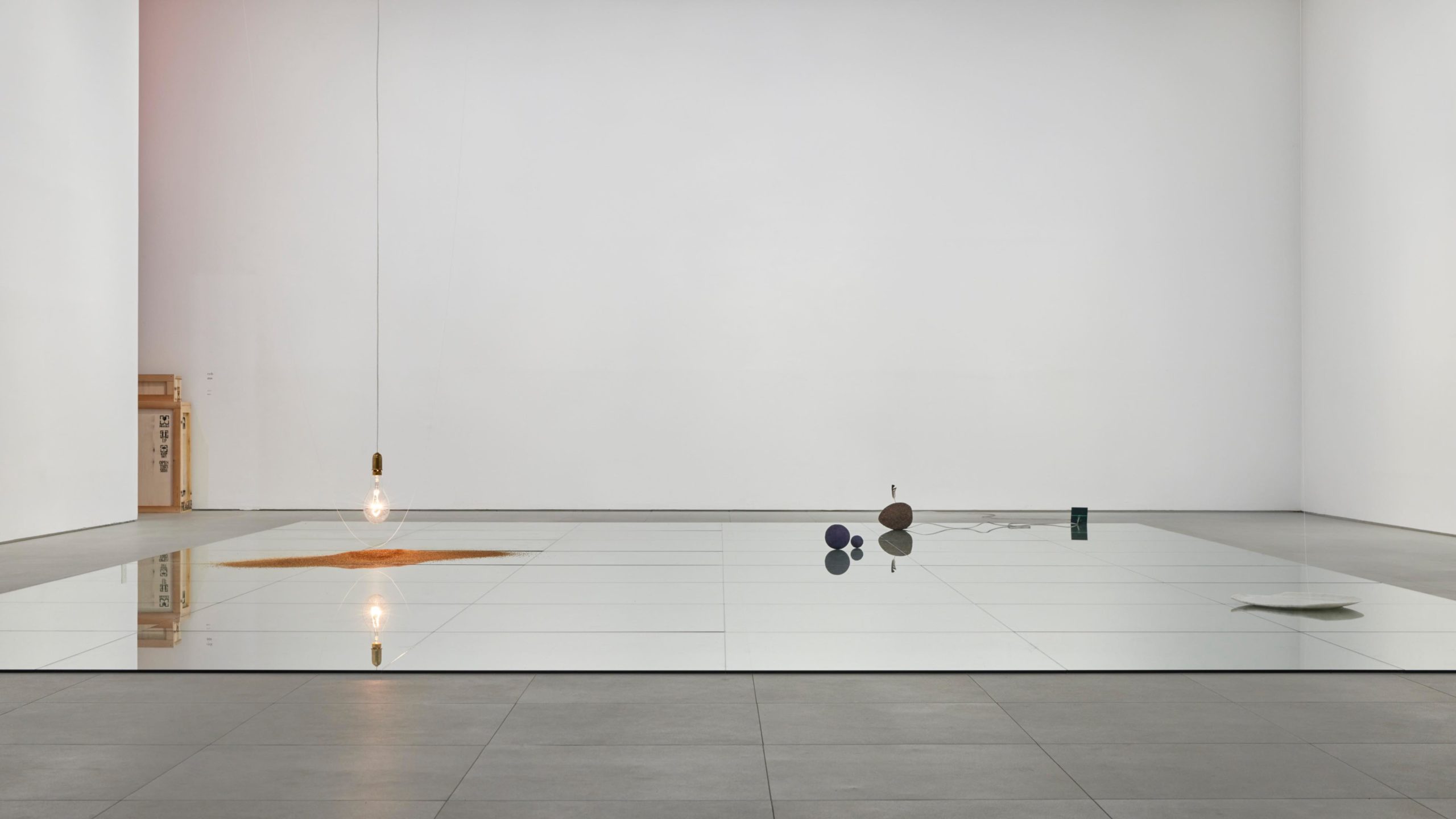
Potassium sorbate, water, silk thread, marble, Soil taken from a stratum 2000years old, chestnut tree dyed with indigo, stones found on the beach, feathers found in Tokyo, solar panel, machinery controlled in binary numbers (birdsong recorded in Kujukuri, August 15-23, 2024), pump, speaker,light bulb, glass plate
Description:
Yasura Takeshi’s work produces representations of energy, from the labour in a rice field to its technocritical arrangement in the artwork. Apart from the organic materials’ recall of the transformed materials in the technological object, the technological processes operating in his artwork produce only low reactions. These anti-spectacular, anti-entertainment artworks are undoubtedly the expression of a radical ecology that criticizes the capitalocene, in other words, an ecosophy.
In The Three Ecologies, Félix Guattari wondered about the productivity gains engendered by technological progress, which seem to inscribe themselves on a curve of logarithmic growth. The question, he wrote, was whether new ecological operators would manage to engage them in an ethico-political dynamic, contrary to the neoliberal imperatives.
We are living in an era known as the “capitalocene”, in which the accumulation of capital is producing major environmental changes. This calls for a new kind of commitment, one that goes beyond the old forms of militancy. This is what Guattari calls ecosophy, a triple ecology – social, mental and environmental – based on an ethico-political and aesthetic dimension.
As they examine the relationship between the organic and the technological, Yasura Takeshi’s artworks seem to come under the heading of ecosophy. His works displace stones, wood and feathers in various technological installations. When he uses earth, he makes sure to specify that it comes from the beach or the mountains. This gives dignity to organic materials, which undergo minor transformations throughout his artistic process. Integrated with technological devices such as solar panels, they also express the discrepancy between technical sophistication and the brutality of technological production processes.
Solar panels are made from complex materials such as plastic, aluminium and silicon, obtained by industrial chemical processes. Silicon, in particular, is produced by reducing quartzite or sand with pure coke. The stones in Yasura Takeshi’s work recall this complex transformation, while their relationship questions the nature of energy.
We often use the expression “energy production” to designate the electricity generated by solar panels, nuclear power plants and so on. The term “energy” refers to different quantities, which are all numerical equivalents for distances and weights. As a standard, the joule (J) expresses energy in physics, while dietetics expresses it in calories (cal), whereas an explosion is measured in “TNT equivalent”. However, what we are really quantifying when we speak of energy is the work of a force insofar as it supplies energy when exerted.
In On Science, Simone Weil developed a reflection on energy, rightly focusing on work, especially human work. She wrote that distances and weights constitute obstacles to work for human beings. Work is a necessity, because every millisecond of our existence is energy production. The slightest of our conscious or unconscious acts exerts a force. Right down to our passive states, everything is work.
It takes “a year of toil and care to bring another harvest to the field”, wrote Weil. In this, work is labour. The energy produced and consumed depends on both vital necessity and social constraint. Everywhere, energy is massively distributed in time and space, without being visible other than through its effects. Nonetheless, it remains the driving force and fruit of our labour. In this sense, energy cannot be thought of as aesthetically outside the ethico-political field of ecosophy. text by Alexandre Taalba
Photo:Akihiro Itagaki (Nacasa & Partners)