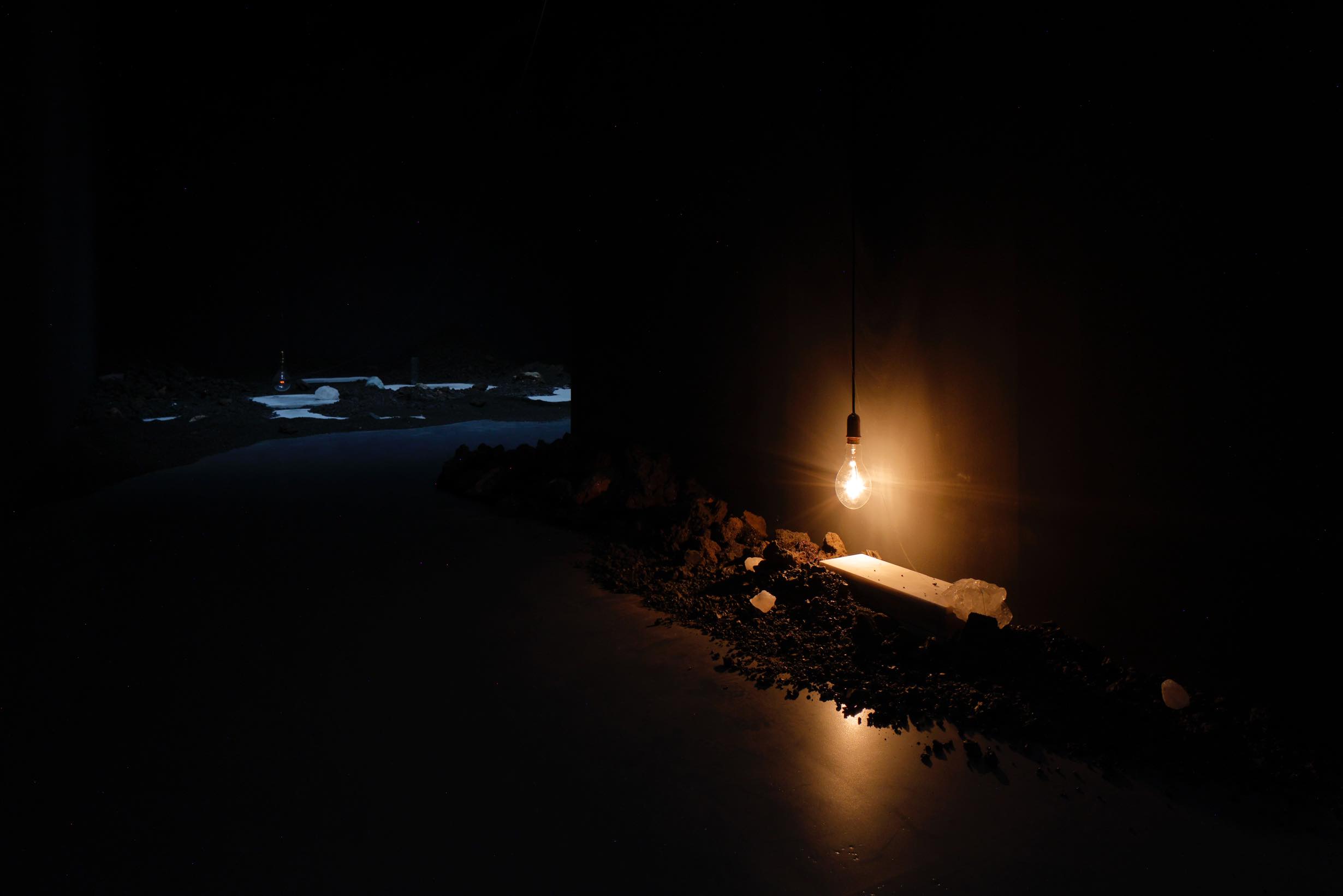
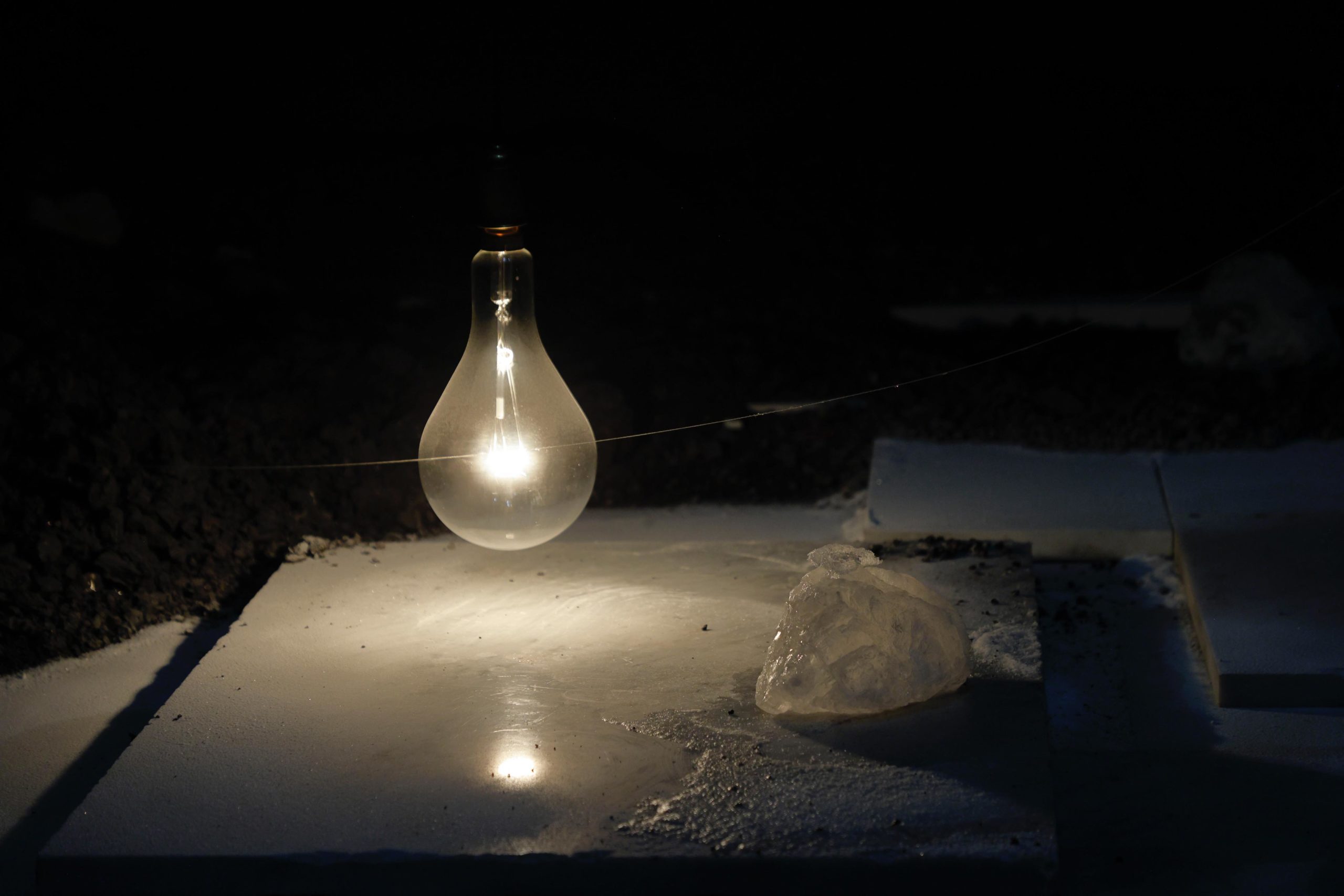
fruiting body(2023)
Group Exhibition:私たちのエコロジー:地球という惑星を生きるために / OUR ECOLOGY: Toward a Planetary Living
Materials:
Rock salt (Pakistan), silk thread (Gunma), seawater (Pacific Ocean), slag (Tokyo), marble (Yamaguchi, Vietnam, Italy, Spain, Iran, Pakistan, Turkey, and Belgium), limestone (Germany), basalt (Shizuoka and Italy), sandstone (India), light bulb, pump, and machinery controlled in binary numbers (birdsong recorded in Annapurna, Nepal, 13 March 2023)
Description:
Yasura Takeshi’s artistic objective is to recognize a radically wide range of entities as beings with individuality, including both living and non-living things such as bacteria, plants, animals, humans, everyday tools, machines, and Al, and to present perspectives that decenter anthropocentric viewpoint. He graduated from Tokyo University of the Arts with an MFA in sculpture in 2018, and completed further graduate studies at the Ecole nationale supérieure des beaux-arts in Paris inIn 2018, he participated in the artist-in-residence program “End of Summer” in Portland, Oregon, the USA. In his fieldwork both in Japan and abroad, he collects natural materials such as soil, stones, and rock salt, and in recent years has been engaging in activities such as soil cultivation, vegetable gardening, and beekeeping that are indispensable to human life on Earth, and producing artworks as extensions of these activities. Yasura’s notable solo exhibitions include We didn’t know they stacked shit that high (Gallery TOH, Tokyo, 2022) and this ground is still alive in Jingumae (Watari Museum of Contemporary Art Light Seed Gallery and vacant lot in front of the Watari Museum of Contemporary Art, Tokyo, 2023). Group exhibitions include Standing Ovation (Atami Art Grant, Shizuoka, Japan, 2021), the 65th Salon de Montrouge (P2021), and Reborn-Art Festival 2021-22 (Miyagi, Japan).His new installation fruiting body, created for this exhibition, combines natural and artificial strata by using marble, which is formed through the uplift of seabed sediment caused by tectonic movements and the crystallization of limestone, along with amorphous slag artificially produced by melting our discharged waste at high temperatures. These strata are combined with rock salt (also the result of tectonic movements and seawater) and the work comprises a series of processes in which the natural and the artificial are intricately intertwined. The metallic sound resonating from the installation is digitized birdsong, which serves as a mediator between the organic and inorganic. The work presents a perspective that connects various eras and entities, advocates the coexistence of humans and non-human organisms and inorganic matter, and proposes a departure from anthropocentrism and a vision of the cycles that exist within the planetary environment
(Tsubaki Reiko, “Our Ecology: Toward a Planetary Living,” Edited by: Mori Art Museum, Publisher:Sayusha, 2023,)
Dimensions variable
Engineer: Saito Yusuke
Production support: SEKISTONE Co., Ltd.;
Recycling Corporation; TOYOBOSHI KOGYO CO., LTD.; Takeyama Co., Ltd.; Bioworks Corporation; Impact Art Works Ltd; Inoue Shuji; Otsuka Ryohei; Shiobara Yuka; Tsunoda Risa
Installation view: Mori Art Museum 20th Anniversary Exhibition Our Ecology: Toward a Planetary Living, Mori Art Museum, Tokyo, 2023-2024
Photo: Kioku Keizo
Photo courtesy: Mori Art Museum, Tokyo